
Bugão’s Small Favor: one small favor, an entire universe
Meet our new pixel-art incremental game, see real development screenshots, and get ready to shape its next steps with the community through Jambor Launcher.
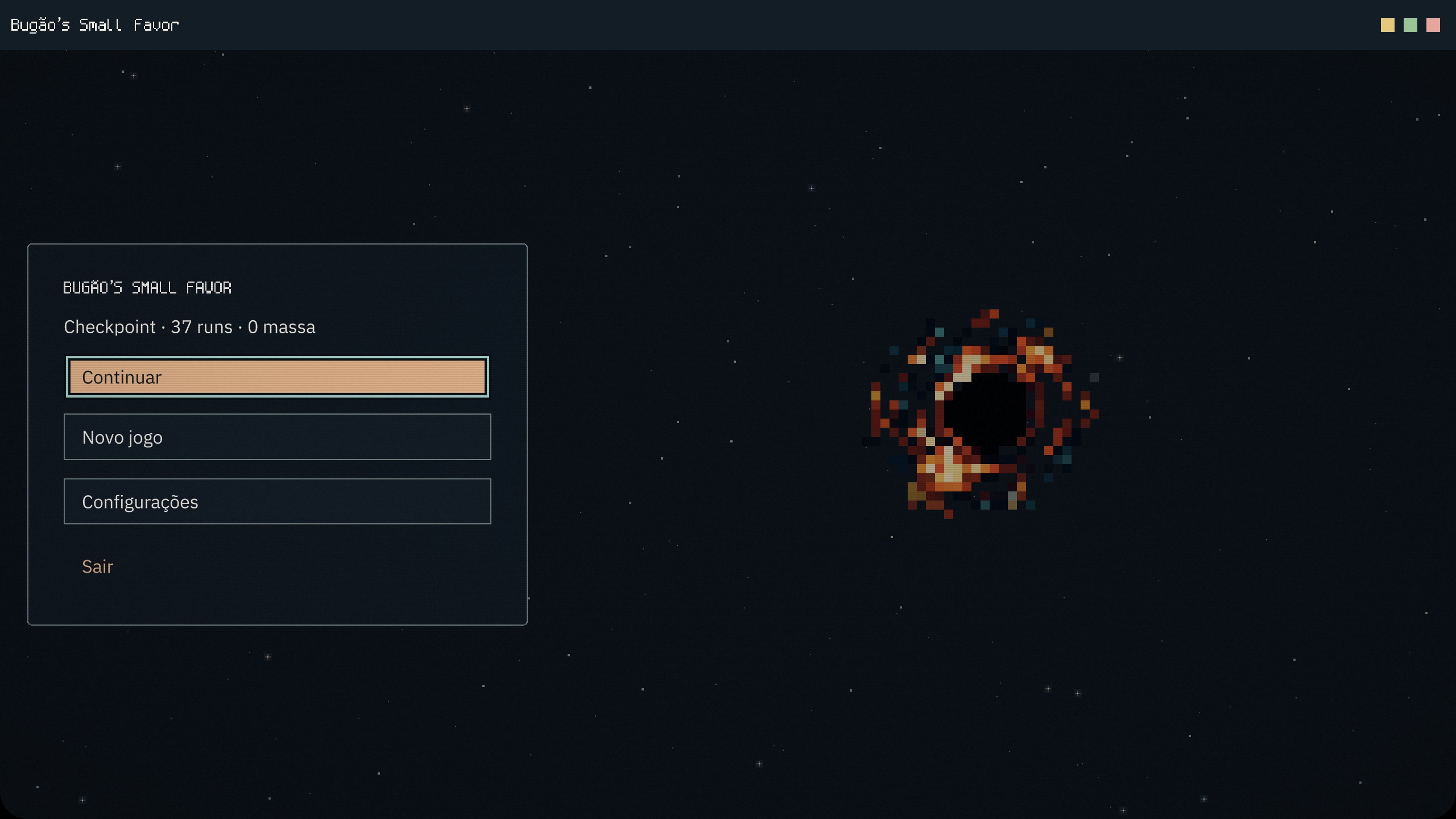
Bugão has a small favor to ask: feed a black hole until the universe is gone. We are building Bugão’s Small Favor, our new narrative incremental game in pixel art, powered by Core Engine.
You start with asteroids and a tool to break them. The idea is to turn fragments into minerals and mass, invest in upgrades, and reach ever larger celestial bodies. All at the request of a cat who seems remarkably relaxed about the consequences.
A game taking shape#
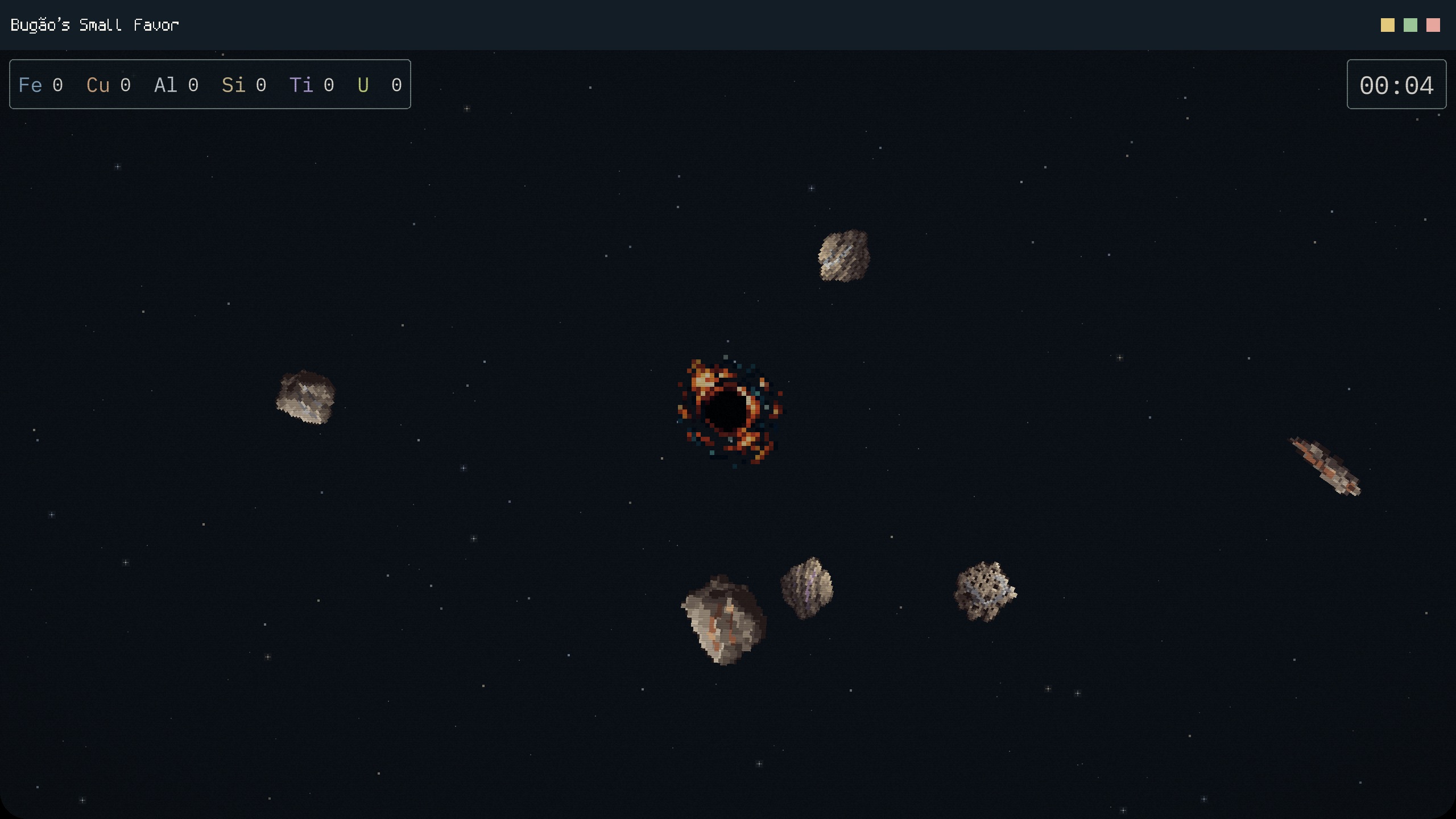
We already have a native build with an opening, menu, settings, asteroid field, collisions, damage, timed runs, and a results screen. The animated black hole, stars, and VHS/CRT presentation set the project’s visual tone.
Since the build shown in these screenshots, development has progressed on attacks, fragmentation, resource absorption, and the first upgrades between runs. Checkpoint saves and an interface in Brazilian Portuguese and English are also part of that foundation.
The project is still in development. Progression and the campaign need further iteration, along with run pacing, upgrade costs, readable effects, and the finishing work on art and audio. Having these systems in the code is a starting point; finding out whether they make the game fun comes next.
Orbits, collisions, and the care behind the pixels#
The playfield’s motion builds on Core Engine’s Runtime, shared clock, scenes, and rendering. The engine coordinates events, updates, and frame presentation; orbital dynamics live in the game’s domain and consume intervals from that same clock. This keeps physics, the run timer, and presentation under one lifecycle, with coordinated pause and suspension.
Asteroids start with positions and tangential velocities derived from a two-body orbital model, accounting for radius, the gravitational parameter, and masses. Initialization uses integer square roots and fixed-point CORDIC to sample the orbital direction. Each asteroid’s axial rotation has a phase independent of its motion around the black hole.
From there, the simulation advances in fixed 10 ms steps — 100 Hz, independent of the rendering rate — using semi-implicit Euler integration and softened central gravity near the black hole. Collisions apply mass-weighted overlap correction and impulses along the contact normal. An impact can change the trajectory: bodies stop following a prescribed circle. Fragments also inherit the velocity of their parent body.
That care includes fixed-point positions and velocities, Int128 intermediates, input validation, and explicit bounds on position, speed, and work per update. The accumulator admits at most 25 steps per update, preventing unbounded catch-up after a stall. Screen projection preserves the same scale on both axes; resizing changes the camera without rewriting the orbits.
For presentation, layered sprites and effects reuse the engine’s scenes, drawing context, and GPU resources. Orbital dust retains position samples to form curved trails, with preallocated storage and a bounded drawing budget. These particles are cosmetic: they never change collisions, minerals, or rewards.
This is orbital physics stylized for the game, with approximate circular contacts and central attraction. Numerical precision and processing bounds help establish a controllable foundation; extreme collisions, readability, and behavior across different machines remain part of validation.
Pixel art, with room to adjust the experience#
We want breaking, colliding, and absorbing to feel satisfying and remain easy to understand. Minerals use symbols and colors, while the scene combines pixels, light, and a finish inspired by older screens.
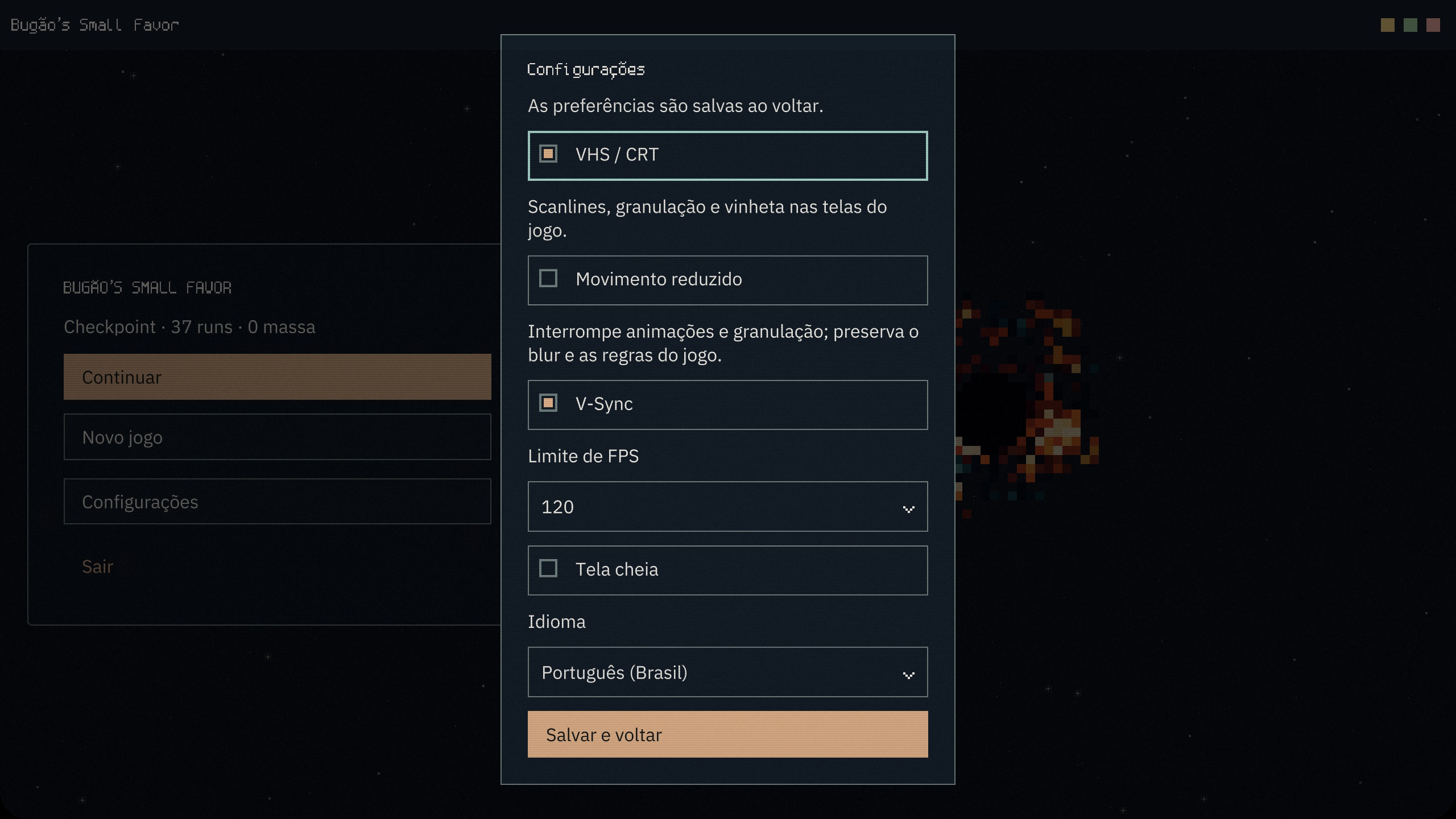
Settings already include options to disable VHS/CRT and reduce motion, alongside video and language preferences. These controls will evolve with the presentation.
Coming soon to Jambor Launcher for testing#
Bugão’s Small Favor will soon be available for testing inside Jambor Launcher. We will share the opening of testing and how to participate here. There is no announced date or public game build available yet.
These tests will put the community in control of the future of development. We want to decide the next steps with the people playing: which improvements deserve priority, where progression drags, which effects need more clarity, and what makes you want to start another run.
Your experiences, suggestions, and reports will guide the next versions. This is a chance to participate while the game is still taking shape and help choose what it becomes.
Explore Bugão’s Small Favor, meet Jambor Launcher, and learn how to install the launcher beta to get ready for testing.
Bugão only asked for a small favor. We will decide the scale of the damage together.